Oven Repair
Why Your Viking Gas Oven Keeps Turning Off While You Cook
A gas oven that seems to switch off mid-cook is usually cycling its bake burner off and on to hold the temperature you set. If the flame dies and never comes back, the likely causes are a tiring igniter, a heat safety cut-out or lost power to the oven.
Written byClifford NakamuraService technician — controls and intermittent faults · 22 years in the trade
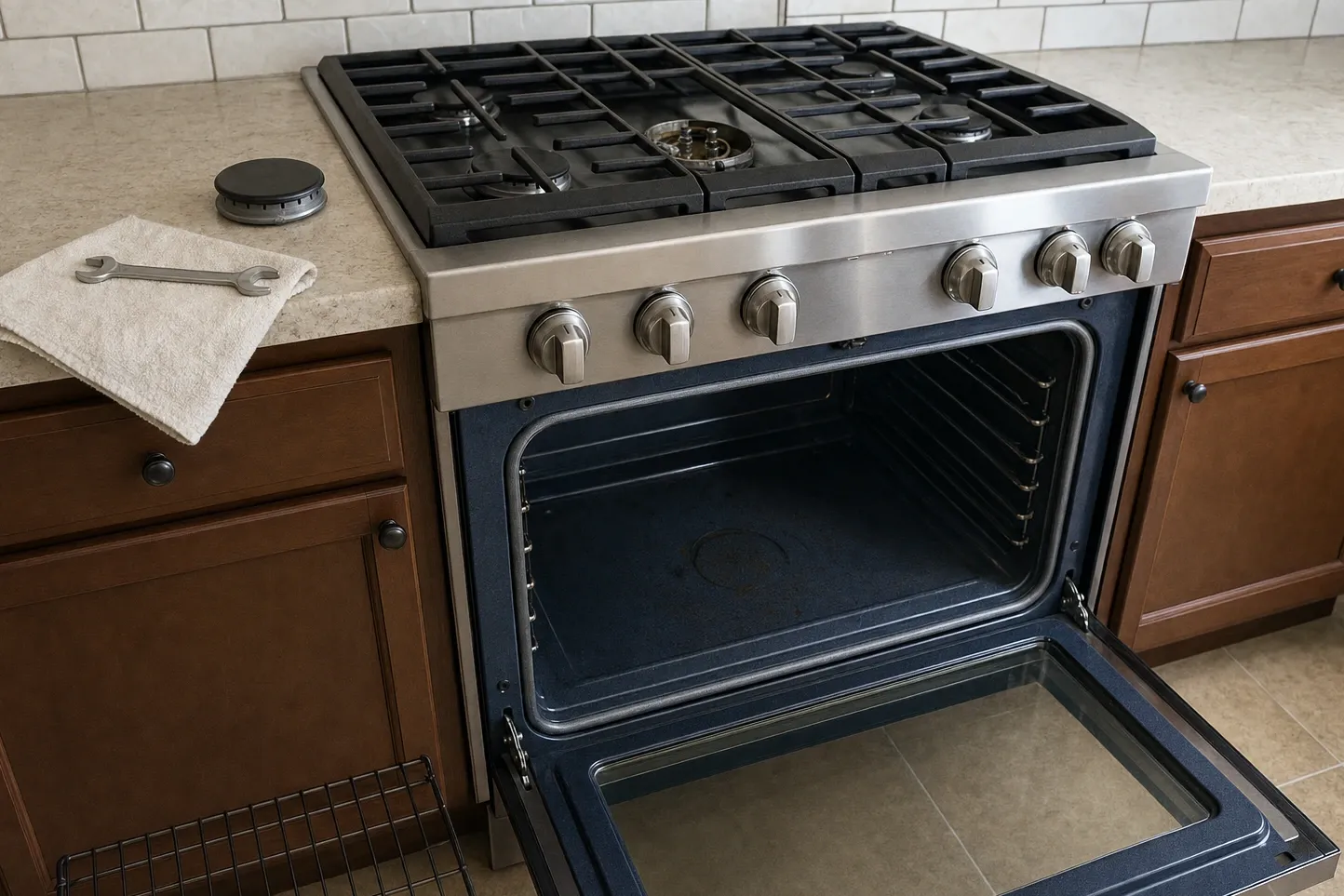
If your gas oven goes quiet partway through a bake and then lights again a few minutes later, it is working normally: the bake burner runs in bursts, shutting off its gas once the cavity climbs a little past your setting and relighting as it cools. The oven is only truly turning itself off when the flame dies for good, the display goes blank, or the cavity drifts cold. Those cases come down to a short list: a weakening igniter, a heat safety device tripping, a forgotten timer, or lost electricity. In Denver, the thin air the burner breathes adds one more.
How a gas oven holds its temperature
An oven has no dimmer switch. Its bake burner is either lit at full strength or off, so the only way to hold a steady bake temperature is to alternate between the two. A sensing bulb or electronic probe inside the cavity reports to the thermostat or control, which opens the gas valve when the reading falls below your target and closes it again once the reading rises above. You hear the pattern as a click, a soft whoosh of flame, then several minutes of silence.
Viking’s 5 Series gas ranges show how much heat is involved. A single 30,000 BTU U-shaped bake burner sits beneath the oven floor, a Gourmet-Glo infrared broiler sits at the top, and the SureSpark ignition system lights both. The 3 Series RVGR3302 hides its own 30,000 BTU convection bake burner. A burner that strong reaches the set point fast, so long quiet gaps are expected once the walls and racks have soaked up heat.
Normal cycling or a real shutdown?
| What you notice | What it usually means |
|---|---|
| Flame goes out, relights within minutes, food cooks on time | Normal cycling |
| Flame goes out, display stays lit, oven cools and never relights | Ignition or gas valve fault |
| Display goes blank or the clock resets | Lost power or a control fault |
| Oven stops at a neat point in the recipe | A cook time or timer was set |
| Oven quits after a long, hot session and works again once cool | Heat protection tripping |
An inexpensive oven thermometer on the middle rack settles most doubts. Read it every few minutes through a full bake. A moderate swing either side of your setting is the cycle at work; a steady slide downward means the burner has stopped relighting.
Why the flame goes out and stays out
Every gas oven has to prove its flame before it lets gas keep flowing, and that safety rule is exactly what makes a failing ignition part look like an oven switching itself off.
Spark-lit ovens, the 5 Series among them, fire an electrode and then check for flame. If the control cannot confirm one, it shuts the gas rather than fill the cavity with unburned fuel. A cracked electrode, a chafed wire or baked-on grease around the burner can break that loop. Many other gas ovens use a glowing hot-surface igniter that must pull enough current to open the gas valve. As it ages it still glows orange, yet it draws a little less over time, until on some calls for heat the valve simply stays shut. The result is an oven that bakes happily for twenty minutes and then quietly cools, which is the classic intermittent complaint.
A gas oven also depends on household current for its control, its igniter and its valve. Viking tells 5 Series owners that a burner knob turned with no clicking at all calls for two quick checks, the cord in its outlet and the breaker or fuse on that circuit, and the same pair applies to an oven that has gone dark.
When heat protection steps in
Ovens carry a high-limit device that cuts the power if the space around the cavity gets dangerously hot, and many also run a fan that pushes air past the controls. A fan that stalls, or vents blocked by sheet pans or foil, lets heat build until the limit trips. The oven goes dead, then often wakes up an hour later once it has cooled, which makes this fault easy to dismiss.
Self-clean is the hardest workout an oven ever gets. Viking self-cleaning ovens climb to as much as 750°F to reduce soil to ash; a clean lasts 3 to 3½ hours on most models, and a 30-minute cool-down comes after that. If the shutting off started right after a clean, mention it when you book, because it narrows the search quickly.
Denver’s thin air and the bake burner
Denver sits about a mile above sea level, so each breath of air the burner draws holds less oxygen than it would on the coast. Gas appliances here are normally set up for that, and one that was not can burn with a lazy, lifting flame. A soft flame is harder for the ignition system to confirm, and incomplete burning can leave deposits on the igniter that make the next start harder still. Our guide to Viking burners burning orange at altitude shows what a healthy flame looks like up here. In a Berkeley bungalow or a newer Central Park home alike, a range that moved with you from a lower city deserves a look at its gas setup.
What to check before you book
- Look on the display for a cook time or delayed start you did not mean to leave active.
- Reset the breaker if it has tripped, and make sure the plug is fully seated.
- Run a full bake with an oven thermometer and note the point where the flame stops relighting.
- Lift any foil off the oven floor and clear whatever is covering the vents.
- Note the model from the rating plate. A 5 Series freestanding gas range puts it in one of three spots: tucked beneath the front-left burner bowl or grate support on that side panel, on the oven’s face frame below the knobs, or behind the control panel over the oven door.
Any smell of gas overrides this list entirely: leave the oven off, get out of the house and call for help from outside.
What the repair involves and what it costs
A technician first confirms which link in the chain is failing, whether ignition, gas valve, temperature sensing, heat protection or the control, before any part is ordered. Typical ranges, with a firm quote after diagnosis: an igniter or burner assembly runs $180–$440, an oven thermostat or heating element $210–$440, and a control board or touch panel $440–$660. The $89 visit pays for the whole diagnosis and comes off the bill as soon as you approve the work. Our Viking oven repair service explains what that visit covers, or call (303) 729-0972 to arrange one.
Follow-up questions
- Why does my oven keep turning off and on while baking?
- Going off and on during a bake is how a gas oven holds its heat, so by itself it is not a fault. The burner warms the cavity a little past your setting, the gas closes, and the flame returns once the air inside cools back down. It only signals trouble if the oven never reaches temperature or the display goes dark.
- Why does my oven turn itself off and stay off?
- An oven that stops completely and will not restart has usually lost power, reached the end of a programmed cook time, or tripped a heat protection device. Check the breaker and the timer settings first. If both look right and the oven stays dead, a high-limit cut-out, a stalled cooling fan or a control fault needs testing with a meter.
- Is it safe to keep using a gas oven that keeps shutting off?
- A short test bake is reasonable only when you smell no gas whatsoever. Gas ovens are designed to close the valve whenever they cannot confirm a flame, so a burner that goes out is normally the safety system working. If you do notice a gas odor, turn nothing on or off, get everyone outdoors and phone the gas utility from there.
- How much does it cost to fix a Viking oven that keeps shutting off?
- Most fixes for this symptom fall into a few typical bands, with a firm quote given once the oven has been diagnosed. An igniter or burner assembly usually runs $180–$440, an oven thermostat or heating element $210–$440, and a control board or touch panel $440–$660. The $89 visit covers the full diagnosis and is credited against the repair if you approve it.
- Can Denver's altitude make a gas oven shut off?
- Altitude rarely shuts an oven down on its own, but it does change how the flame burns. With less oxygen in the air a mile up, a burner never adjusted for Denver can burn soft and unsteady, and a weak flame is harder for the ignition system to confirm, which can end a bake early.