Oven Repair
Viking Oven Baking Badly in Denver: Altitude or a Cold Oven?
Pale, domed cakes and roasts that take forever get blamed on Denver's elevation. Altitude changes the recipe, never the thermostat. How to measure what your Viking oven is really doing before deciding it is normal.
Written byClifford NakamuraService technician — controls and intermittent faults · 22 years in the trade
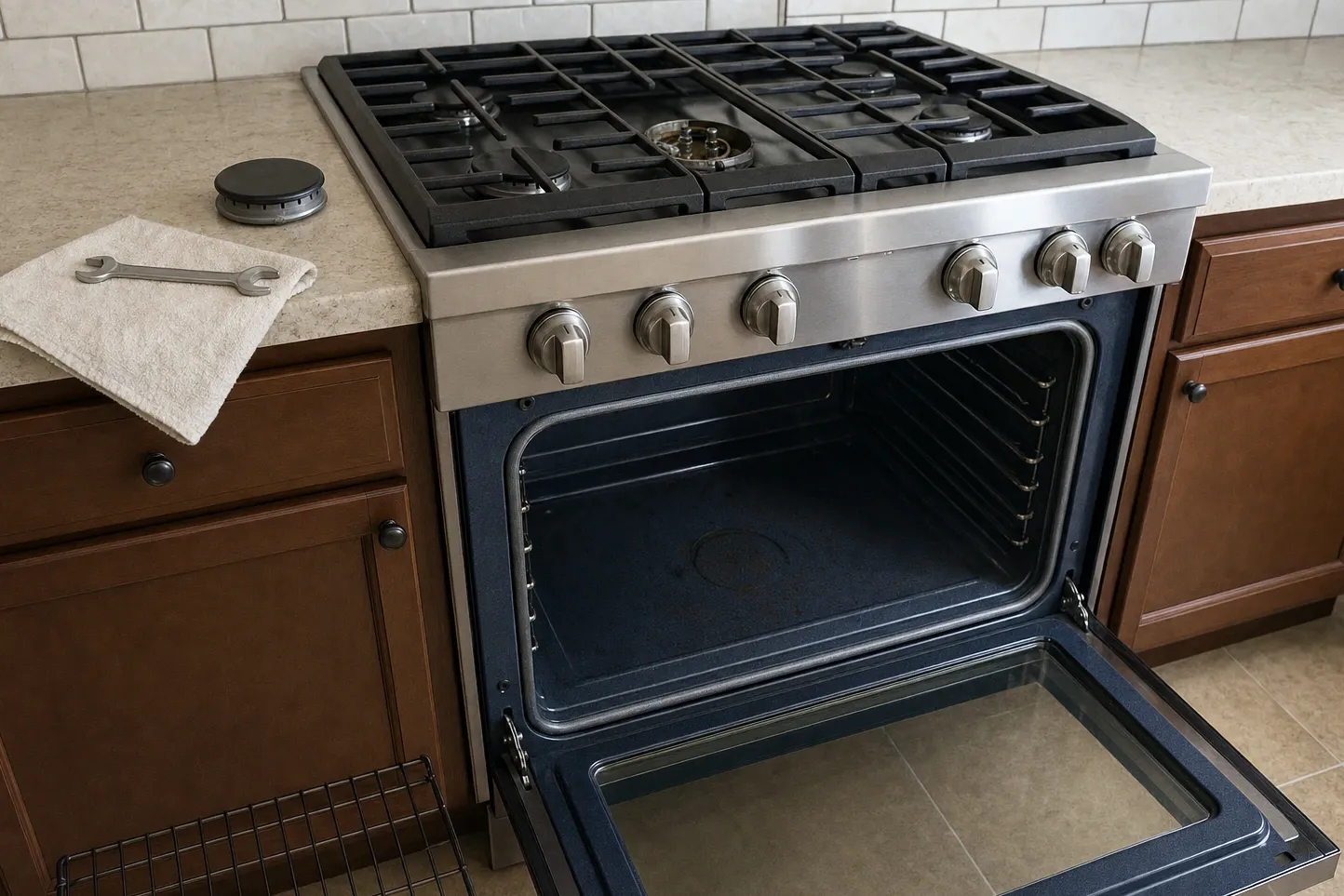
Denver kitchens produce a specific complaint: cakes come out pale and domed with a crack across the top, bread rises fast and collapses, and a roast that the book says needs an hour is still not done. It gets attributed to the altitude, and then nothing is done about it for years. Altitude is a real factor here, but it changes what the recipe should say. It does not change what the oven does when you set it to 350.
Those are two separate problems, and it is worth knowing which one you have before you rewrite every recipe you own.
What altitude actually changes, and what it does not
At 5,280 feet the air pressure is about eighty-two per cent of sea level. Three things follow, and none of them involve the oven’s thermostat.
Water boils at roughly 202°F instead of 212°F, so anything cooking in liquid runs cooler and takes longer. Leavening gases expand more readily against the lower pressure, which is why cakes rise dramatically and then fall — the structure sets too late to hold what the rise created. And moisture evaporates faster, so batters dry out and doughs proof quicker than the timings assume.
The standard corrections are recipe corrections: slightly less leavening, slightly more liquid, a little extra flour for structure, and often an oven setting fifteen to twenty-five degrees higher to set the crust sooner. If your baking improves when you make those adjustments, your oven was never the problem.
What altitude does not do is make an oven run cold. The sensor measures the air in the cavity, the control compares it to the set point, and the elements or the gas burner make up the difference. That loop works the same at any elevation.
Measure it, do not guess
This is the test worth doing before anything else, and it needs nothing but an oven thermometer.
- Hang a decent oven thermometer from a rack in the middle of the cavity, not on the floor of the oven and not touching a wall.
- Set the oven to 350°F and leave it a full thirty minutes after the preheat signal. A Viking cavity holds a lot of heat and takes longer than the beep suggests to settle.
- Read the thermometer without opening the door any further than you must.
- Read it again fifteen minutes later, and once more fifteen minutes after that.
Now look at the pattern rather than the single number. Steady and low — three readings clustered around 325 — is a calibration or sensor problem, and it is the most fixable version of this. Swinging widely — 310, then 375, then 330 — is a control or sensor fault, and no offset will tame it. Correct at the top of the cavity and cold in the middle points at circulation: a convection fan that has stopped, or a vent path packed with dust behind the cabinet. Correct throughout means the oven is fine and the recipes need the altitude treatment.
The faults behind a genuinely cold oven
A drifting temperature sensor. The resistance thermometer in the cavity wall reads high as it ages, so the control believes the oven is hotter than it is and shuts the heat off early. It is measurable cold and hot, cheap, and the most common single cause.
A bake element failing at one end. On an electric oven, look at the element with the oven on. If it glows unevenly, or one leg stays dark, it is delivering a fraction of its rated heat. The oven still gets warm, so it is easy to miss.
A weak glow bar on a gas oven. The igniter has to draw enough current to open the gas valve. As it ages the draw falls, the valve opens late, and the oven takes minutes to light — or lights, then drops out mid-bake. Measuring the current is the test; the appearance of the bar tells you very little.
A dead convection fan. In a fan oven the temperature is only correct because the air is moving. When the fan stops, the top of the cavity overheats, the bottom stays cool, and the panel reports something in between.
A vent path that has packed up. Denver’s dry, dusty air is unkind to the gap behind a built-in cabinet. Restrict the vent and heat backs up where it should not, which skews the sensor and, in the worst cases, trips a thermal cut-out mid-roast.
What a visit looks like, and when to book one
The cavity gets measured over a full cycle rather than sampled once. Sensor resistance is read cold and at temperature and compared to the specification for your model, which is the number that decides whether calibration will hold. Elements or the glow bar are tested for actual draw, not inspected. The fan, the door seal, the hinges and the vent path get checked, because heat lost through a tired seal produces exactly the same symptoms as a cold oven.
If the oven turns out to be accurate, that is worth knowing too — you will be told the recipes need adjusting rather than sold a sensor.
Book it if your measurements come back more than about twenty degrees out, if the readings swing, if the oven takes minutes to light, or if it dies part-way through cooking and only works again once it has cooled. The $89 service call covers the visit, the measurements and the explanation, credited against the repair once you approve the work. Have the model number to hand when you call; it is on a plate around the opening somewhere, and whoever answers will talk you to it.
Follow-up questions
- At what point does an oven running cool actually matter?
- Within about ten degrees of the set point, once fully preheated, is normal for a domestic oven and no recipe will notice. Twenty-five or more is a fault: at that point bread and pastry stop working and roasting times stretch out unpredictably.
- Can I recalibrate it myself from the control panel?
- Many Viking ovens allow a calibration offset, and if the oven is a steady twelve degrees low then an offset is the correct fix. It is the wrong fix for an oven that swings wildly or drifts as it goes — that is a sensor or element problem, and offsetting it just moves the error around.
- Why does my oven preheat quickly and then bake badly anyway?
- Preheat is usually judged by the sensor near the top of the cavity, which warms first. If the heat is not being circulated — a failed convection fan, a blocked vent path behind the cabinet — the middle of the oven never reaches the temperature the panel is reporting.