Range Repair
Viking Burners Burning Orange in Denver: It Is the Altitude, Not the Gas
Tall orange flames, soot on the pans and a simmer that will not hold are the signature of a Viking range still jetted for sea level. How to tell an altitude problem from a real fault before you pay for either.
Written byClifford NakamuraService technician — controls and intermittent faults · 22 years in the trade
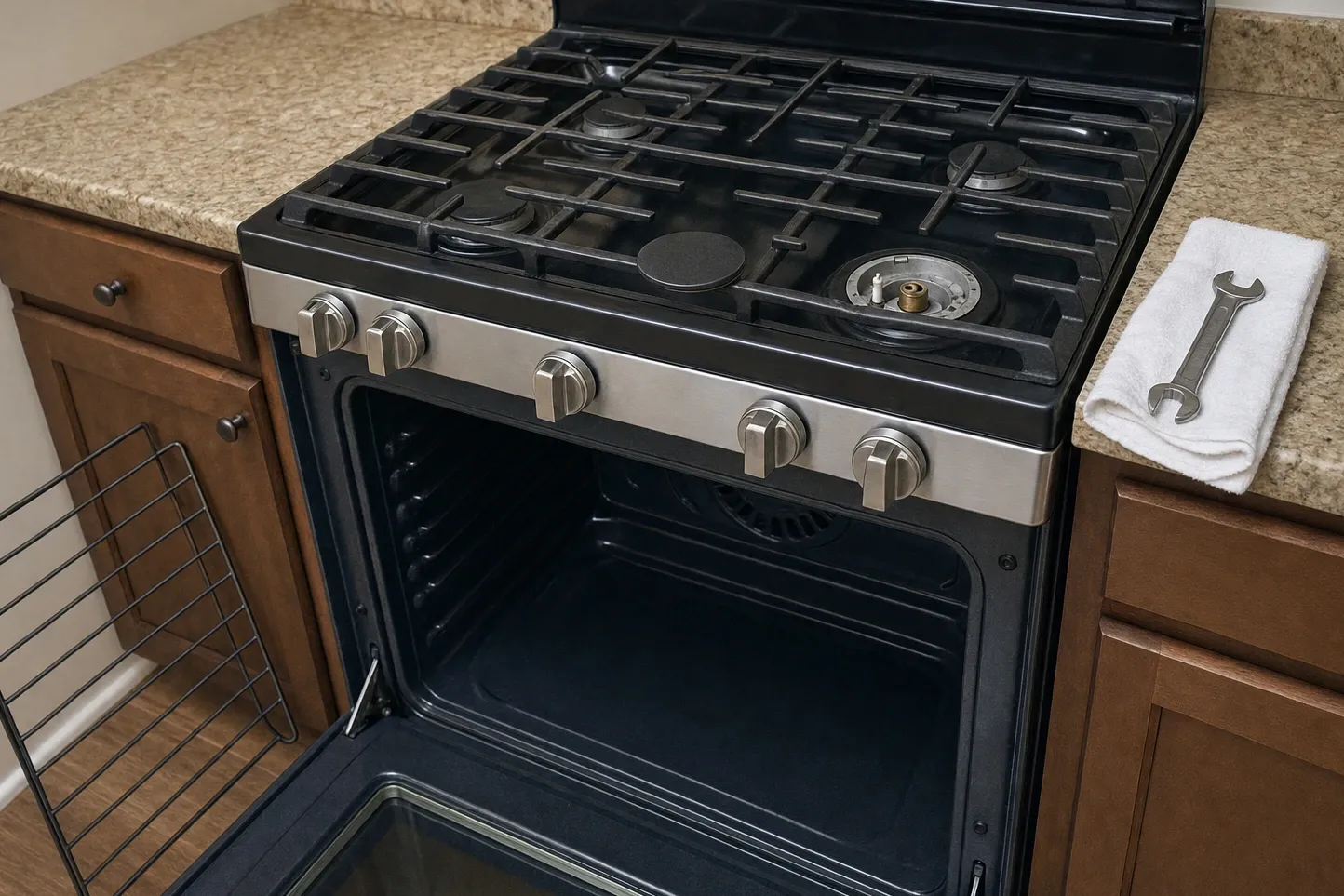
A Viking burner in good order burns a tight blue cone with a small, sharper blue core. If yours are running tall, lazy and orange, with soot building on the bottom of your pans and a simmer that dies whenever the vent hood is running, the range is almost certainly still set up for sea level. That is one of the most common faults in this city, and it has nothing to do with the burner being worn out.
What the orange flame is actually telling you
Colour is a fuel-to-air ratio readout. Blue means the burner is getting enough air to burn the gas completely. Orange and yellow mean it is not: some of the gas is cracking into soot before it burns, and the incandescent carbon is what you are seeing. The flame gets longer because combustion is finishing further away from the burner port.
Denver sits at 5,280 feet. There is roughly seventeen per cent less oxygen in a given volume of air here than at the coast. The burner does not know that. Its orifice — the drilled brass fitting that meters gas into the mixing throat — was sized on the assumption of sea-level air. Feed the same amount of gas into thinner air and the mixture goes rich. Every burner on the range does it at once, which is the giveaway: a fault in one burner is a fault, but all of them misbehaving together is a set-up problem.
Manufacturers deal with this by supplying a high-altitude orifice set: the same fittings with smaller drillings, which meter less gas so the ratio comes back into range. Fitting them is routine work. The problem is that it is often skipped — by an installer working from a sea-level manual, by a delivery crew who set the range down and left, or by a previous owner who never knew the kit existed.
The five-minute check before anyone comes out
You can get a long way on your own, and everything here is safe to do with the range cold and the burners off except where noted.
- Look at all the burners together. Light them and stand back. Are they all the same lazy orange, or is one worse than the rest? All of them means set-up; one of them means that burner.
- Check the underside of a pan you use often. A grey-brown film that wipes off with a cloth is soot, and soot is proof of incomplete combustion rather than an impression.
- Watch the low flame with the hood on full. A correctly jetted burner holds its simmer. A rich one is already marginal, and the extra air the hood pulls across the cooktop is enough to snuff it.
- Find the rating plate. On most Viking ranges it is behind the kick panel or on the frame inside the lower door. Note the model and serial. If a previous technician converted the range, there is often a sticker or a pen mark recording it.
- Check what your gas is. A range plumbed for propane but jetted for natural gas, or the reverse, produces its own version of this fault and is a more urgent one. If the flames lift off the ports or you can smell gas, stop and call.
What you cannot sensibly do yourself is change the orifices. They are small brass parts torqued into a manifold carrying live gas, they are model-specific, and getting one cross-threaded turns a straightforward job into a manifold replacement.
What is not the altitude
Being fair to the equipment matters, because “it is just the altitude” is also a convenient excuse for a real fault. These look similar and are not the same thing:
A blocked burner port. Boil-overs bake into the ports around one burner and distort the flame pattern on that burner only. The flames go uneven and ragged rather than uniformly orange, and often one segment of the ring stays unlit.
A crooked or warped cap. Viking sealed burners rely on the cap seating flat. A cap that has been dropped, or one refitted at a slight angle after cleaning, throws the flame sideways and can make one burner roar while the rest behave.
A misadjusted air shutter. Where a model has adjustable shutters, someone closing them down chokes the primary air and produces the same rich flame the altitude does. This is worth checking before ordering parts, because it costs nothing to correct.
A failing spark module or electrode. This does not change the flame colour, but it is the other thing people describe as “the burner not working properly”. Endless clicking after the burner has lit is an electrode soaked by a spill or a module on its way out, not a gas mixture problem.
What a proper altitude visit involves
The work itself is unglamorous and largely consists of reading things correctly. The orifice sizes are checked against the model’s own high-altitude table and against the elevation — not against a rule of thumb. The regulator is verified for the gas actually supplied. Where the model has adjustable shutters, they are set with the burner running. Then every burner is run from high to low and back, and the simmer is held with the vent hood on full to prove it survives real kitchen conditions rather than a still room.
If your range also has an oven that has never baked properly, say so when you book. The same visit can measure the cavity, and it is worth knowing whether the oven is genuinely running cold or whether the recipes simply need adjusting for this elevation. Those are two different problems with two different fixes, and they get confused constantly.
When it is worth having someone out
If every burner is orange, if pans are sooting, or if the simmer will not hold, the range needs converting and that will not improve on its own. Correcting the jetting also makes the cooktop work the way it was designed to — a Viking simmer that stays lit is much of the reason for buying one.
Call it in with the model number to hand. The $89 service call covers the visit, the reading of the set-up and a clear explanation of what has to change, and it is credited against the repair once you approve it. If it turns out your range was converted properly and something else is wrong, you will be told that instead.
Follow-up questions
- Can I just turn the burner down to stop the orange flame?
- No. The colour is telling you the mixture is rich, not that the flame is too big. Turning the knob down lowers the gas and the air together, so the ratio stays wrong — you get a smaller orange flame that still sooties the pan.
- Does every Viking range in Denver need converting?
- Every gas appliance installed here should have been set for the altitude, and plenty were not. If the range came with the house, or arrived from a dealer who ships nationally, assume nothing and have the orifice sizes read against the model and against 5,280 feet.
- Is an orange flame dangerous?
- A rich flame burns dirtier and produces more carbon monoxide than a correctly set one, so it is not something to live with indefinitely. If you also smell gas, or the flame lifts away from the burner, shut the supply off at the valve and call before using the range again.